June 2026 market update
Canada Life - Jul 08, 2026
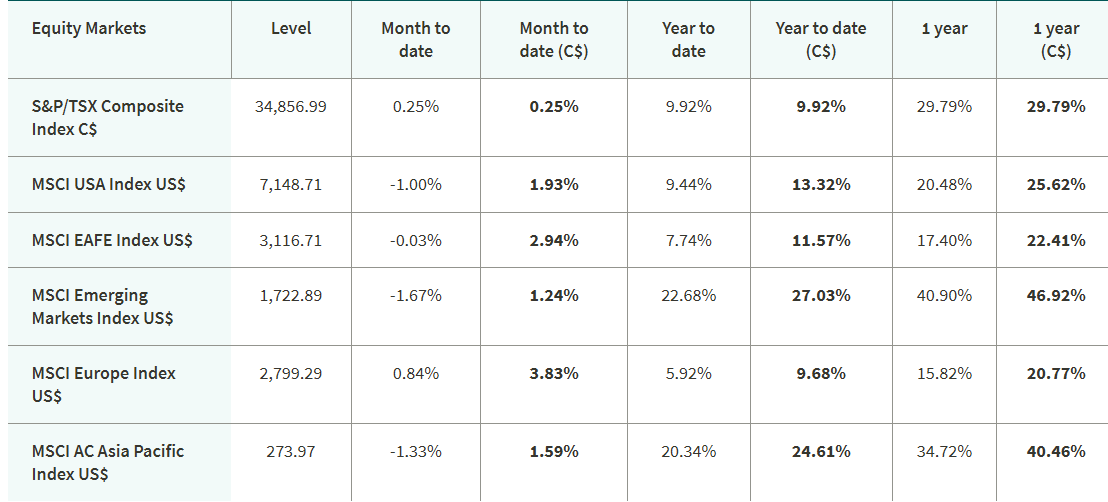
How are inflation, interest rates and global events influencing markets? While global equity markets were largely unchanged in June, the outlook for inflation and monetary policy continued to drive market conversations.
Introduction
Global equity markets finished largely unchanged over the month of June. Despite the U.S. and Iran reaching an interim peace deal, bringing down oil prices, investors are concerned about the lasting impact of the conflict on inflation and the global economy. Artificial intelligence (AI) stocks saw some periods of volatility over the month as investors wondered about the return on investment in AI.
Inflationary pressures around the world accelerated. Major central banks are carefully monitoring the long-term impact on their respective outlooks for inflation before any interest rate changes. The Bank of Canada (BoC), U.S. Federal Reserve Board (Fed), Bank of England and Bank of Japan all held their policy interest rates steady in June. The European Central Bank, meanwhile, raised its policy interest rates by 25 basis points in an attempt to contain inflation.
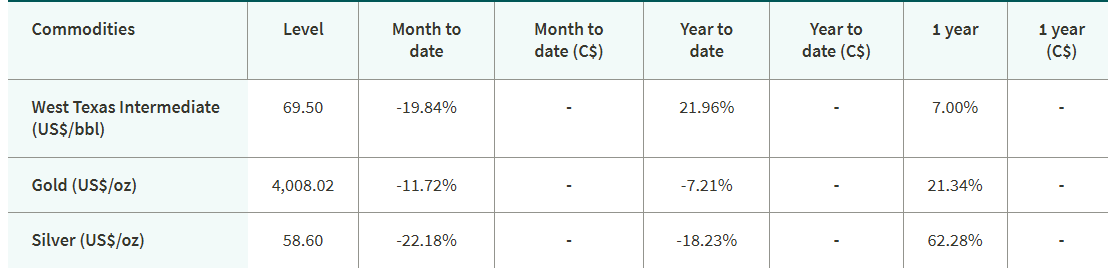
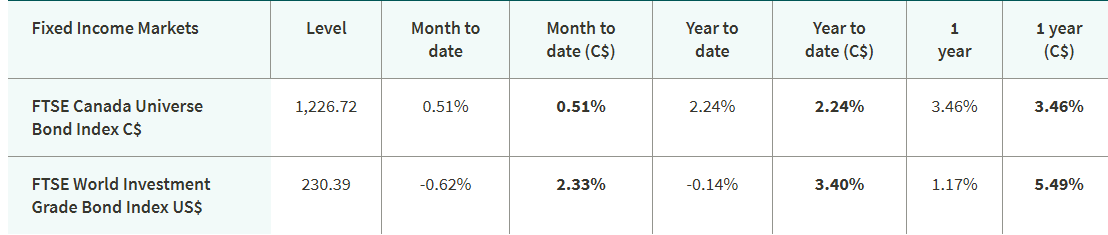
In Canada, the S&P/TSX Composite Index inched higher, led by the financials sector. U.S. equities finished lower. The yield on a 10-year Government of Canada bond finished slightly lower. The yield on a 10-year U.S. Treasury bond edged higher. The price of gold declined over the month.
The U.S. and Iran sign interim peace agreement
In mid-June, the U.S. and Iran signed an interim peace agreement to end more than 100 days of conflict in the Middle East, easing one of the biggest sources of uncertainty weighing on global markets this year. Mediated by Qatar and Pakistan, the deal calls for Iran to reopen the Strait of Hormuz, a critical shipping route for global oil, and for the U.S. to lift its naval blockade of Iranian ports. While the agreement is only a first step, with longer-term issues such as sanctions on Iran and Iran’s nuclear program still to be negotiated, it was enough to ease investor fears of prolonged oil supply disruptions. Oil prices fell sharply on the news, with benchmark crude oil dropping to its lowest level since the war between the U.S./Israel and Iran began, as traders priced in the return of normal shipping traffic through the strait. Lower oil prices are a welcome development for Canadians, since gas prices have been a major driver of the recent rise in inflation. If the de-escalation of conflict in the Middle East holds and oil prices keep falling, it could help cool inflationary pressures and soften the impact on Canadian consumers and businesses. The price of oil finished lower over June.
Bank of Canada facing a difficult environment for monetary policy
At its June meeting, the BoC held its benchmark overnight interest rate steady at 2.25% for a fifth straight time, choosing to stay the course rather than move in either direction. BoC officials are walking a fine line: the economy has been weak and uncertainty around U.S. trade policy persists, but rising oil prices tied to the conflict in the Middle East have kept inflation elevated. So far, the BoC sees little evidence that pricier energy is spreading into other goods and services, which gave it room to wait rather than react. As reported in June, Canada’s annual inflation rate climbed to 3.2% in May, its fastest pace since December 2023, driven by a sharp jump in gasoline prices and higher grocery costs. With more money going toward fuel and food, household budgets are getting squeezed, leaving less room for discretionary spending. Meanwhile, businesses are facing higher input costs that can eat into profits. While headline inflation has been elevated, core measures of inflation have remained close to the BoC’s 2% target, reinforcing the BoC’s analysis that energy inflation has not spread to other consumer products. Overall, this combination of relatively soft economic growth and elevated inflation points to an economy facing real challenges, and it suggests the BoC may remain patient before considering any interest rate changes in the months ahead.
U.S. inflation measures rise above 4%
Key measures of inflation in the U.S. accelerated to over 4% in May, demonstrating the impact higher energy prices caused by the conflict in the Middle East are having on consumer prices. As reported in June, the consumer price index rose by 4.2% on a year-over-year basis, its highest level since April 2023 and the third straight monthly acceleration. Meanwhile, the Fed’s preferred inflation gauge, the personal consumption expenditures price index (PCE), told a similar story, climbing by 4.1% year over year in May, which was also its highest level since 2023. In both reports, the surge in prices was driven mainly by energy costs, with gasoline prices up more than 40% from a year ago amid the ongoing conflict in the Middle East. This rapid rise in living costs is squeezing American households, particularly through higher gas, food and shelter expenses, and could lead consumers to pull back on other spending. However, oil prices have already started easing following progress on a U.S.-Iran peace deal, which may help cool inflation in the months ahead. The Fed kept the target range for its federal funds rate unchanged at 3.50%–3.75% at its June meeting. Fed officials did express some division about the future path of interest rates. With inflation expected to persist and economic activity relatively stable, expectations are growing the Fed will need to raise interest rates in 2026 to help cool inflationary pressures.
China’s retail sales decline for first time in over three years
In June, it was announced that retail sales in China fell by 0.6% year over year in May, marking the first annual decline since December 2022. May’s decline was headlined by a drop in spending on big-ticket, discretionary items. Automobile sales sank by 16.1%, and steep declines were also seen in sales for home appliances, furniture and building materials. By contrast, spending on essentials like food, beverages and clothing held up better. The weakness in consumption stands in contrast to China’s industrial sector, which continued to grow in response to strong exports, highlighting an uneven economy where factories are outperforming household spending. Still, soft domestic demand adds to pressure on China’s government to introduce stronger stimulus measures to support consumers in the second half of 2026. Combined with a weak property market, China’s domestic consumers may need a boost to help China’s economy return to outsized growth. The People’s Bank of China (PBOC) held its one- and five-year loan prime rates steady at its June fixing. Ongoing weakness in domestic demand and the property market may louden calls for the PBOC to lower interest rates further.
Market performance - as of June 30, 2026